
Data Center Electrical Design:
Key Challenges in Power Distribution, Cooling, Power Quality & Protection
Modern data centers are becoming more power-intensive every year, and their electrical infrastructure has to keep pace to deliver safe, stable and uninterrupted power. A single mistake in power distribution, cooling, power quality, or protection can cause downtime and equipment failure.
A well-planned electrical design protects equipment and supports long-term energy performance of data centers. There are four major challenges: power distribution, cooling, power quality, and protection.
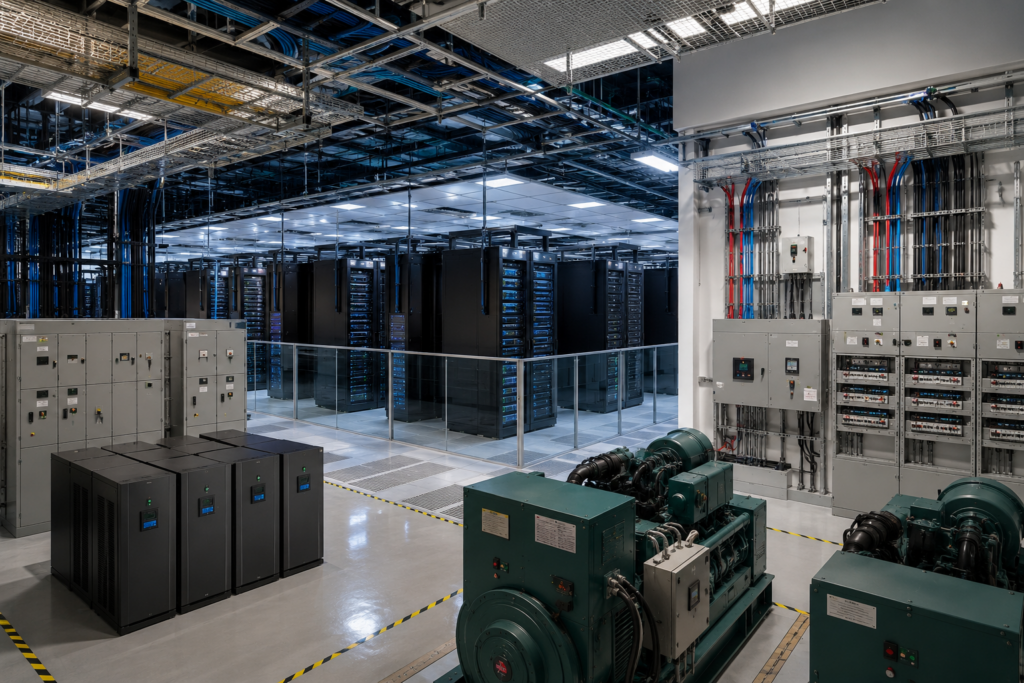
1. Power Distribution Challenges
As power demand per rack increases, data centers need robust and properly sized power distribution systems. HT/LT network configuration, transformer capacity, and switchgear selection must be carefully planned to handle current loads and future expansion.
Key power distribution challenges include:
- Rising power density demands larger, smarter distribution networks
- Balancing HT and LT distribution across the facility layout
- Sizing transformers correctly for current and future loads
- Selecting switchgear that handles fault levels safely
- Calculating cable sizing to minimize voltage drop losses
- Planning redundancy and backup power for zero downtime
Getting these fundamentals right requires careful engineering from the start. Our HT/LT Power Distribution service is built specifically to help data centers design distribution networks that are efficient, scalable, and resilient.
2. Cooling Load Challenges
Cooling and electrical design are deeply interconnected. High-density server loads generate more heat, and cooling systems themselves — HVAC units, chillers, pumps — draw substantial electrical power that must be planned for.
Key cooling-related electrical challenges include:
- High-density racks push cooling systems to work harder
- HVAC and chiller loads add major electrical demand
- Load diversity between IT and cooling affects sizing
- Energy-inefficient cooling inflates overall electrical consumption
- Capacity planning must include current cooling requirements
- Future cooling upgrades need electrical headroom built in
The key takeaway for designers is simple: electrical infrastructure must be planned around both current and future cooling requirements, not just IT load projections.
3. Power Quality Challenges
Sensitive IT equipment is unforgiving when it comes to power quality. Harmonics, voltage fluctuations, and voltage imbalance can distort waveforms, stress equipment, and degrade lifespan over time.
Key power quality challenges include:
- Harmonics distort waveforms and stress electrical equipment
- Voltage fluctuations and imbalance risk tripping protection devices
- Low power factor increases losses and utility penalties
- Transients and electrical noise disrupt sensitive IT hardware
- UPS systems introduce their own power-quality concerns
- Sensitive servers demand consistently clean, stable power supply
The best way to identify these issues early is through detailed power system studies. Load flow, harmonic, and power quality analyses help assess how the system will perform under actual operating conditions. Baseline’s Power System Studies service helps identify these risks early and address them during the design stage, rather than reacting to failures after commissioning.
4. Protection & Safety Challenges
Protection design must handle fault conditions without tripping healthy circuits. Short-circuit protection, overcurrent protection, and relay coordination help isolate faults quickly while keeping the rest of the system running.
Key protection and safety challenges include:
- Short-circuit and overcurrent protection must be sized precisely
- Relay coordination isolates faulty circuits while keeping the rest of the system running
- Earthing design protects both personnel and sensitive equipment
- Lightning protection guards against damaging external transient surges
- Fault-current paths must be mapped across the system
- Protection devices need coordinated, facility-wide response planning
All of these devices — fuses, breakers, relays, need to work together in a coordinated protection scheme. One of the most common causes of unnecessary downtime is poorly coordinated protection. Our Earthing & Lightning Protection and Power System Studies services help data centers develop safe and effective protection system.
Even experienced teams can fall into avoidable traps. Some of the most common mistakes include:
- Underestimating future electrical loads
- Incorrect transformer or cable sizing
- Ignoring cooling loads during electrical capacity planning Poor or skipped power-quality assessment
- Inadequate redundancy planning
- Improper protection coordination
- Poor earthing design
- Not conducting required power system studies
Conclusion
Power distribution, cooling, power quality, and protection are not separate design problems, they’re interconnected parts of the same system. A transformer sized without considering cooling loads or a protection system designed without power quality data can lead to downtime and equipment failure later.
Frequently Asked Questions
What are the major electrical design challenges in data centers?
The four major challenges are power distribution, cooling load management, power quality, and protection & safety. Each affects the reliability and scalability of the facility and needs to be addressed together rather than in isolation.
Why is power distribution important in data center design?
Power distribution determines how efficiently and reliably electricity moves from the utility feed to IT racks. Poor distribution design leads to voltage drop, load imbalance, and limited capacity for future growth.
How do cooling loads affect data center electrical design?
Cooling systems are significant electrical loads themselves. As server density increases, cooling demand rises, which means electrical infrastructure must be sized to handle both IT loads and cooling loads together.
What power quality problems can affect data center equipment?
Common issues include harmonics, voltage fluctuations, voltage imbalance, poor power factor, transients, and electrical noise — all of which can degrade or damage sensitive IT equipment over time.
Which power system studies are required for data centers?
Typical studies include load flow analysis, short-circuit analysis, harmonic analysis, and protection coordination studies. These help identify risks before they cause operational problems.
Why are earthing and lightning protection important in data centers?
Proper earthing protects both personnel and sensitive electronic equipment from fault currents, while lightning protection shields the facility from external transient surges that could otherwise cause major damage.
How can electrical design support future data center expansion?
By planning for future power needs, the electrical system can support data center expansion more easily. Proper transformer, cable, distribution, and protection capacity can also reduce the need for major upgrades later.